

AIARE Avalanche Courses
AIARE 1, Avalanche Rescue, and AIARE 2 courses across Washington — taught at Mount Baker, Snoqualmie Pass, and Mount Rainier by professional guides, in exactly the terrain you'll travel.
Every backcountry skier, splitboarder, and winter climber who travels in avalanche terrain needs avalanche education. AIARE (the American Institute for Avalanche Research and Education) is the US standard, and its courses give you a repeatable framework for planning trips, reading terrain and snowpack, making decisions with a team, and performing a companion rescue.
We teach the full progression in the Cascades' deep maritime snowpack — the same terrain you'll ski — with low student-to-instructor ratios and guides who do this for a living.
The AIARE progression
AIARE 1 — Start here
Your first avalanche course: a 3-day introduction to trip planning, terrain and snowpack assessment, and group decision-making. The right starting point for anyone heading past the ski-area boundary.

Avalanche Rescue
A focused 1-day companion-rescue course. Skills perish without practice — AIARE recommends retaking Rescue every season, and it can be taken on its own or alongside AIARE 1 or 2.
AIARE 2 — Advanced decision-making
The next step for experienced backcountry travelers: deeper snowpack analysis, more complex terrain, and leading decisions. Requires AIARE 1 and a season of touring experience.
Refreshers
Already certified? Knock the rust off at the start of the season with a shorter refresher before you commit to serious terrain.
Mentorship & packages
Go further than a course alone — ongoing mentorship and bundled intro-to-backcountry options that pair training with guided days.
Where we teach
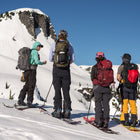
We run avalanche courses at three Washington venues so you can train close to where you ride: Mount Baker (deep snow and varied terrain), Snoqualmie Pass (closest to Seattle), and Mount Rainier.
When to take a course
Start of season
AIARE 1 and season-opening Rescue refreshers before the snowpack gets complex.
Peak season
AIARE 1 and AIARE 2 in a developed snowpack with real decision-making.
Spring
Late-season courses and bigger objective terrain as the pack stabilizes.
Rescue
Retake Avalanche Rescue annually — companion-rescue skills fade without practice.
Why train with us
Low ratios, local guides, and courses taught in real terrain — not a classroom. We're based in Glacier, Washington and run the full AIARE progression every winter, so you can start with us and keep building season over season.
Avalanche course FAQ
Which avalanche course should I take first?
Start with AIARE 1. It's the foundational 3-day course and the prerequisite for everything else. If you only have one day, Avalanche Rescue is a valuable standalone, but AIARE 1 is the real starting point.
What is the difference between AIARE 1 and AIARE 2?
AIARE 1 teaches the core framework for planning, terrain and snowpack assessment, and decision-making. AIARE 2 goes deeper into snowpack analysis and complex terrain and is aimed at experienced travelers ready to lead decisions. AIARE 2 requires AIARE 1 plus a season of touring.
How often should I retake Avalanche Rescue?
AIARE recommends refreshing companion-rescue skills every season. Rescue is a perishable, time-critical skill, so a short annual refresher before the season is well worth it.
Do I need AIARE 1 before AIARE 2?
Yes. AIARE 2 builds directly on AIARE 1, and you should also have at least a season of backcountry touring experience before taking it.
What gear do I need for an avalanche course?
A transceiver, shovel, and probe, plus your touring setup (skis or splitboard with skins, or snowshoes for some courses). Rentals are available — just ask when you book, and we'll send a full gear list.
Where do you teach avalanche courses?
At Mount Baker, Snoqualmie Pass, and Mount Rainier in Washington. Snoqualmie is closest to Seattle; Baker offers the deepest snow and most varied terrain.
We'll help you pick the right course
Tell us what you ride and what you've trained in, and we'll point you to the right AIARE course, level, and location.